
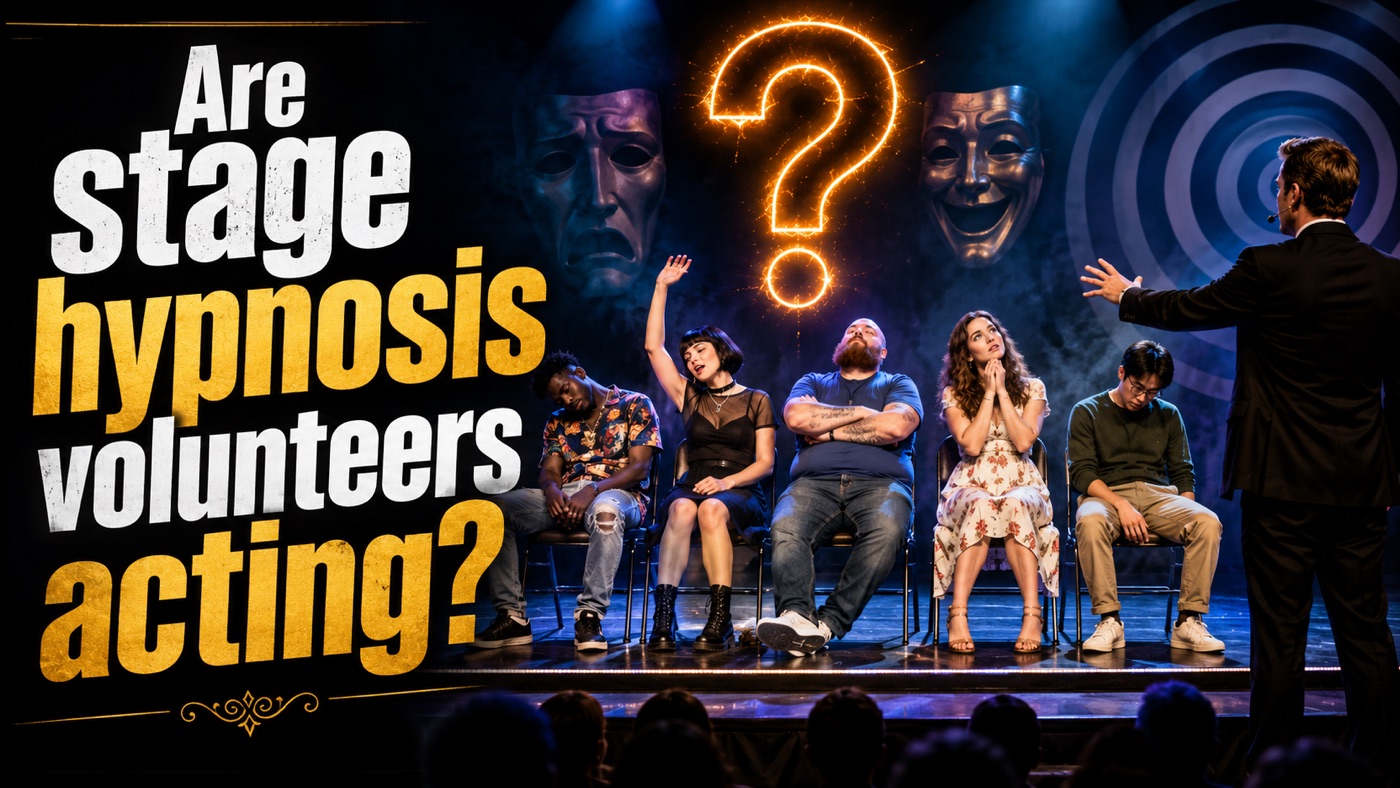
I get asked this more than almost any other question, usually with a little smirk: “Come on, Michael… those people on stage are actors, right? They’re in on it.”
So let me answer it as plainly as I can: no. The volunteers in a real stage hypnosis show are ordinary, random people from the audience — not paid actors, not plants, not stooges I flew in for the night. And here’s the part that surprises people: using actors wouldn’t just be dishonest, it would actually make the show worse. Let me walk you through why, because once you understand what’s really happening up there, the whole thing gets a lot more interesting than “they’re faking it.”
Why actors would actually ruin the show
Think about where most of my shows happen — corporate events, cruise ships, colleges, private galas. In almost every one of those rooms, the people watching know the people on stage. That’s Karen from accounting. That’s their roommate. That’s the buttoned-up manager nobody ever expected to let loose. The comedy isn’t just “a stranger acting silly” — it’s that their own friend or co-worker is doing something they’d never do sober. You can’t fake that, and you can’t hire it.
The magic of a hypnosis show is that it’s unpredictable and real. Nobody in that room, including me, knows exactly what’s about to happen. The moment you swap in actors, you kill the one thing that makes it electric. So the honest way isn’t just the ethical way — it’s the way that gets the bigger laughs.
What’s really happening: they volunteered
The word does the heavy lifting here: volunteer. These people raised their hand and came up on their own. Nobody is being controlled against their will — that’s not how hypnosis works, and it’s a big part of why the old “mind control” idea is more Hollywood than reality. I dig into that in the truth about brainwashing, but the short version is this: I cannot hypnotize anybody against their own free will. I say that from the stage, out loud, every single time.
What hypnosis really is — focused attention, heightened suggestibility, and a willing imagination — I break down in how does hypnosis work. A volunteer isn’t a puppet. They’re a willing partner in a bit of theater, and my job is to create a space that feels safe enough and fun enough for them to let go.
The real skill isn’t fakery — it’s selection
Here’s the thing most people never realize. The secret of a great hypnosis show isn’t tricking people into pretending. It’s choosing the right people — and quietly letting go of the wrong ones.
Before I ever get to the fun stuff, I run a series of what we call suggestibility tests. To the audience they look like part of the entertainment, and they are. But for me, they’re a filter. I might bring 30 people up and finish with 15. During those few minutes I’m asking myself: Who’s genuinely responsive? Who’s focused? Who’s just clowning around trying to prove me wrong? Who’s faking it? The ones who aren’t really with me get thanked and sent back to their seats — nicely, and usually without them even realizing it’s happening.
So the irony is beautiful: people accuse me of using fakers, when a huge part of my craft is weeding the fakers out. By the time the real show starts, everyone left on that stage genuinely wants to be there and is genuinely responding. Some of the psychology behind why people say “yes” and go along with the flow, I get into in the power of yes sets.
You can’t fake the tells
Even if someone tried to act their way through it, I’d know — because there are physical signs of genuine trance that are extremely hard to counterfeit. The head begins to drop, chin toward the chest. The shoulders droop and go slack. Breathing slows and drops into the belly. You see fluttering eyelids, a slackening jaw, that unmistakable “heavy” stillness.
Then there are the phenomena themselves — an arm that’s gone rigid as a bar (we call that catalepsy), or a hand a person genuinely can’t pull apart no matter how hard they try. An amateur actor doesn’t reproduce that on command in front of 300 people. A hypnotist who’s been reading these signs for decades spots the difference instantly.
Why some people go under and others don’t
Suggestibility runs on a spectrum, and it has nothing to do with being weak-minded — that’s one of the biggest myths out there, and I bust a pile of them in 7 myths and misconceptions of hypnosis. In fact, focused, imaginative, intelligent people often make wonderful subjects. What matters is willingness, imagination, and how safe and relaxed a person feels in the moment. Some folks drop in seconds. Others take a while. A few never really let go — and that’s completely fine. Those are simply the ones who don’t make the final cut.
“There are no bad subjects”
I train my students on a principle I borrowed from Milton Erickson, one of the greatest hypnotists who ever lived: there are no bad subjects. I walk onto every stage believing that the people who come up can do it, and I tell them so — constant, quiet encouragement, a “that’s right” here and there. That belief and that encouragement are a real part of why it works. It’s not manipulation and it’s not acting. It’s rapport, confidence, and a whole lot of practiced skill — which, by the way, is exactly what can be taught. If that world intrigues you, start with so you want to be a stage hypnotist.
The bottom line
So, are hypnotist volunteers actors? No. They’re real people, having a real experience, doing genuinely funny things of their own free will — guided by someone who has spent years learning how to choose the right volunteers, read the signs, and hold the room. That’s not a trick. That’s a craft. And honestly? It’s a far better story than “they were all actors.”
Are hypnotist volunteers paid actors?
No. They’re real, random members of the audience. Actors would actually weaken the show — audiences recognize their own friends on stage, and a faker can’t reproduce the genuine physical signs of trance. The skill is in selecting and guiding willing people, not planting them.
Can you be hypnotized against your will?
No. Hypnosis needs the willing cooperation of the subject. I can’t make anyone do something against their free will — the volunteer has chosen to take part. If someone truly doesn’t want to, they simply won’t respond, which is exactly why we screen those people out.
Why do some people get hypnotized more easily than others?
Suggestibility is a spectrum. Some people focus and let go quickly; others hold on longer. It’s not about intelligence or willpower — it’s about willingness, imagination, and feeling safe and relaxed.
Do the volunteers remember what happened?
Usually yes, at least in part. Some remember everything, some recall it like a hazy dream. Either way it’s light-hearted, consensual fun and the volunteer is safe the whole time.
Are the volunteers just playing along to be funny?
A few try — and spotting them during the suggestibility tests and sending them back to their seat is part of the job. What’s left on stage are genuinely responsive people, and real phenomena like catalepsy are very hard to fake convincingly.